Copyright Universal Jewellery Limited 2026 | Company number: 11339738
Credit subject to status and affordability. Universal Jewellery Limited FRN: 1013120 trading as Aardvark Jewellery are authorised and regulated by the Financial Conduct Authority. We are a credit broker not a lender — credit is subject to status and affordability, and is provided by Mitsubishi HC Capital UK PLC. Terms & Conditions Apply. The register can be accessed through www.fca.org.uk
From CAD to Champagne: How We Make Your Engagement Ring | Aardvark Jewellery
From CAD to Champagne: How We Make Your Engagement Ring
7 min read
From CAD to Champagne: How We Make Your Engagement Ring
When you see a finished engagement ring, it’s easy to get distracted by the shiny bit in the middle. Understandably so. We spend quite a lot of our time getting distracted by those ourselves.
But before that ring reaches its box, it passes through several pairs of hands. There are designs to work through, models to check, metal to cast and stones to set. Somewhere between choosing your sapphire and planning where to hide the ring box, there’s an entire workshop process taking place.
So I thought I’d take you through what actually happens when we make your engagement ring at Aardvark, including the small part of its journey that takes place just down the road.
First, we work out what you have in mind
The starting point looks a little different for everyone.
You might arrive with a folder full of inspiration images and very firm opinions about claw shapes. You might know you want something green, but that’s about as far as you’ve got. Both are perfectly good places to begin.
For a bespoke ring, we talk through your ideas, stone preferences, metal, budget and timings. We also consider the practical details: how the ring will sit on your finger, how you plan to wear it and whether it needs to work alongside a wedding band.
You might also find your combination through our
ring builder
. That lets you explore settings, stones and metals, with an AI preview to help you picture the result.
Whichever route you take, our team still needs to turn those choices into a precise design.
CAD: where the details come together
CAD stands for computer-aided design. We use it to build a detailed three-dimensional model of your ring, working through its dimensions, proportions and structure.
This is where we consider how high the stone sits, how the setting holds it, the shape of the band and all those little details you might only notice when you turn a ring sideways.
There’s quite a lot going on in a very small space.
You’ll receive CAD previews to review before we move into production, giving you the opportunity to look closely and discuss any changes with us.
If you started with the ring builder, this is the next step beyond its AI-generated image. The CAD preview shows the actual design we’ve created for your ring, with the correct structure, proportions and stone placement.
Every ring ordered through the builder still receives that individual attention from our team. There’s very much a person behind the screen.
A short walk to our casting partners
We carry out all the manufacturing ourselves apart from two stages: 3D printing and casting. For those, we work with Stonehouse, who are just a short walk from us in the Jewellery Quarter.
The reason is fairly straightforward. We don’t have the production volume or the space to justify a professional casting setup of our own. It requires specialist equipment and a dedicated working area, and it makes sense for us to work with a business set up for exactly that purpose.
It’s one of the advantages of being based here. We can design a ring in our studio, have it printed and cast nearby, then bring it back to our own benches for the rest of the work.
From the screen to something we can hold
Once the CAD is approved, Stonehouse produces a physical wax or resin model using high-resolution 3D printing.
Up to this point, your ring has existed as a digital design. Now there’s something that can be held, turned over and examined in the real world.
The model allows us to check the design before casting. It’s a workshop stage rather than something we send out to you, and the model is used up during the casting process.
It has a short life, but an important job.
A brief encounter with molten metal
At Stonehouse, the model is prepared for casting by attaching a small channel, called a sprue, through which the metal will eventually flow.
It’s then surrounded by a specialist mould material. Heating removes the wax or resin, leaving a cavity in the shape of your ring.
Molten gold or platinum fills that space. Once the metal has cooled and the mould material is removed, we have the raw casting.
This is a particularly satisfying stage: the design has become a precious-metal object.
It also looks considerably less glamorous than you might expect. A freshly cast ring still has plenty of work ahead of it before it resembles the polished piece you see on our website. That work takes place back with our team at Aardvark.
Back at our benches
With the casting back in our workshop, we remove the casting channel and begin cleaning up and finishing the metal.
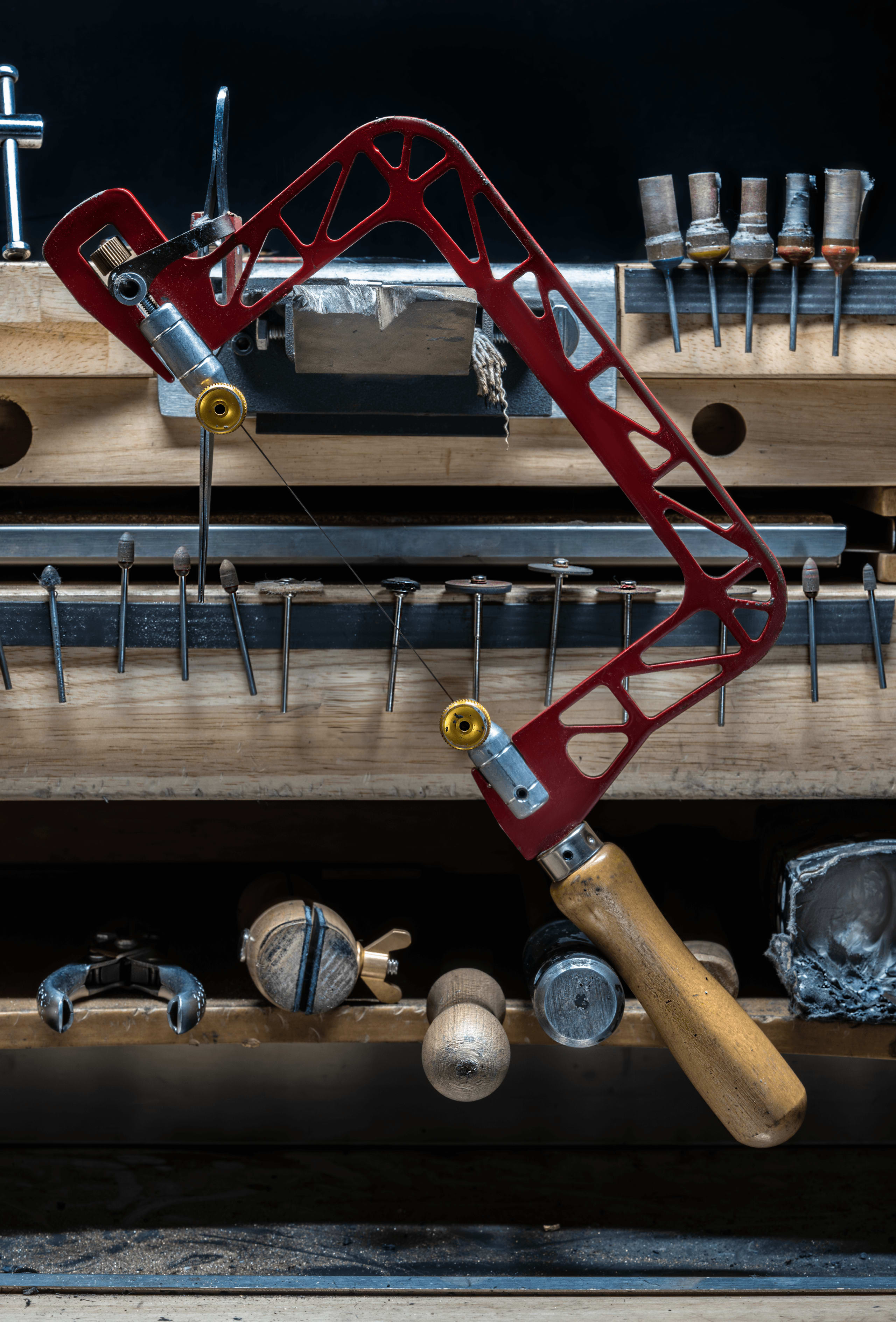
Our team works through the surfaces with hand tools and polishing equipment, refining the details and preparing the setting for its stones. Areas that will be harder to reach once the gemstones are in place need attention now.
This is one of those stages that’s easy to overlook in the finished ring. You see a smooth surface or a neatly defined detail, without necessarily thinking about the work needed to get it there.
The people at the bench think about it quite a lot.
The moment the stones go in
Next, the ring reaches our stone setter.
Your centre stone and any accent stones are carefully fitted and secured in the setting. The technique depends on the design, whether that involves claws, a bezel around the stone or small diamonds set into the band.
This is precise work, carried out under magnification. The stones need to sit correctly, line up as intended and be held securely.
It’s also when the ring really begins to look like the piece you imagined. That loose sapphire you chose now has its place, and all the decisions about metal, proportions and surrounding stones come together.
For me, seeing those choices become a finished combination is one of the pleasures of the job.
A final polish and a proper look
After setting, our team gives the ring its final polish and inspection.
We check the security of the stones, the structure of the ring, the finish and how the finished piece matches the design. It’s a chance to look closely at everything together, as well as the individual details.
There are several different skills involved in making a ring, and each stage affects the next. Good design needs careful casting. A good casting needs thoughtful finishing. The setter needs a properly prepared setting.
The finished piece is the result of everyone doing their part.
Finally, the ring box—and perhaps the champagne
Once the checks are complete, your ring is placed in its Aardvark presentation box, ready to make its way to you.
Our typical production time is six to eight weeks, though we’ll discuss the timing of your particular ring with you. If you have a proposal date or another occasion in mind, tell us at the beginning so we can plan around it.
Then comes the part we hand over to you: the proposal, the surprise, or simply the pleasure of opening the box together.
Champagne is optional, of course. Spending rather a long time staring at your hand is entirely understandable.
I still find it remarkable that something which begins as a conversation and a model on a screen can become a piece of jewellery someone wears every day. There’s a lot of careful work between those two points, carried out by our team and our neighbours here in the Jewellery Quarter.